
Building a Business That Supports Your Wellbeing (Not Just Your Clients')
When we choose to become dog professionals, most of us are not that interested in how to "run a business".
We want to help - to support dogs and guide families. We want to promote physical and emotional wellbeing for everyone involved.
But it is very easy to build something that does this for our clients and our dogs ... and leaves us feeling worn out and drained.
We have done it ourselves.
We have had businesses that supported everyone else beautifully.
From the outside, everything looked fine. There was income. There were clients. There were courses running and products being created.
People felt supported and more connected to and understanding of their dogs.
But for us, it felt different. We were tired in a way we couldn't quite shift. Decisions felt heavier than they should. There was a sense of always being "on duty" - and always slightly behind!
It's very easy in those moments to assume the problem is you.
Maybe you need better time management. Maybe you just need to push through. Maybe you should be more disciplined.
But often, it isn't about structure or effort at all. It's about alignment.
An aligned business isn't just one that pays the bills.
It's one that supports you across the whole of your life. It allows you to feel physically steady rather than constantly depleted. It gives you enough financial security to breathe. It leaves space for your own dogs, your own learning, your own relationships. It reflects who you are - not who you think you ought to be.
And that's where things often drift.
Without realising it, we build according to what we see around us.
We add the services people ask for. We start a blog because someone says blogging is essential. We open another platform because everyone else is there. We sign up to the next strategy that promises clarity.
None of those things are wrong in themselves.
But without a clear sense of where we are actually going, they start to pull us sideways. We end up busy, but not necessarily moving towards anything that feels deeply like us.
When we decided to leave Empowered Dog and close our individual businesses to set up HeartDog, we had a very clear vision. Janet had spent several months travelling round the coast of Britain in a camper van and wanted the freedom to do that more. We had just commissioned Molly, our lovely red camper van, designed for off-grid living and working.
We wanted our new business to be flexible enough to fit that life, rather than the business dictating what we could and couldn't do.
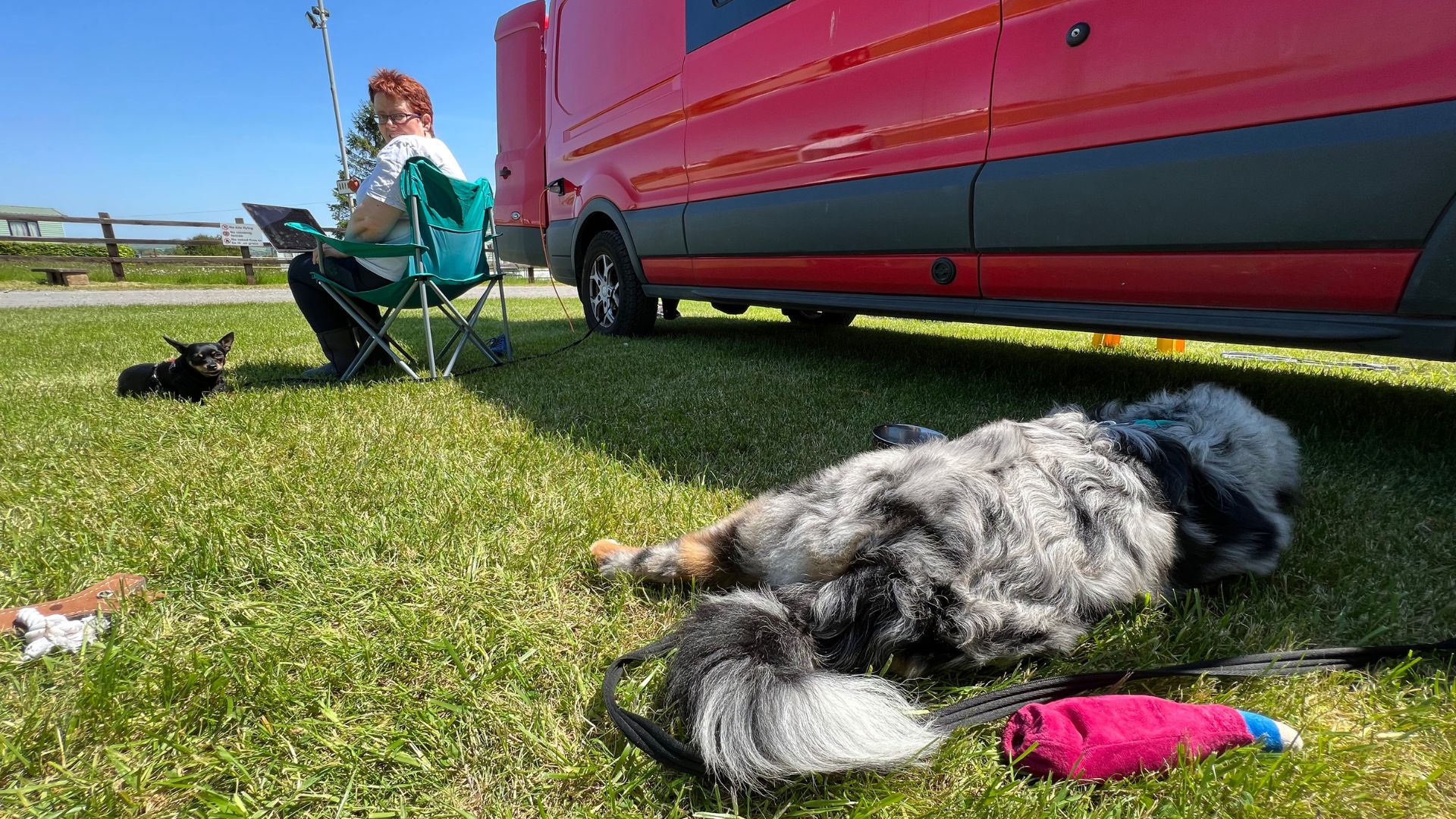
And it has largely worked. We travel a lot. We spend time at home in Northumberland and with family in Devon.
We travel in Molly to film with different people in different locations and just to explore and relax. We have fixed sessions but they are mostly online so can be done anywhere with internet - and our few in-person sessions are compressed into weekends rather than spread across several weeks.
We're now in the process of another shift.
One that will allow us to focus more clearly on the two interests - education and media - that we have.
It will create clearer messaging and stronger partnerships. It will enable us to lean more fully into our specific strengths and interests. It will bring us back to working with both guardians and professionals.
But what it won't do is change our lifestyle.
Freedom to move around and travel is non-negotiable for us. As we shape the next phase of our business, we will ensure it supports that vision.
Vision is key to building a business that supports your wellbeing.
When there's no vision, every opportunity feels urgent. Every decision feels heavy. Every "should" sounds convincing. We find ourselves being tempted by shiny things at every turn.
But vision doesn't have to mean having a five-year plan or a detailed roadmap.
It can be much simpler than that. It can be asking yourself what you want your ordinary days to feel like. Do you want slow mornings? Do you want to travel? Do you want to work intensively for three days a week and then have time for yourself?
How much income do you actually need to feel secure? How much time do you want with your own dogs? Do you crave flexibility, adventure, routine, collaboration, time for hobbies?
Vision gives you direction - and a filter for decisions.
Every suggestion, every idea can be passed through your vision filter. Does this choice move me closer to the life I want to build? Or does it just look good from the outside? If it doesn't move you closer to your vision, you can let it go - even if everyone else is doing it!
Overwhelm is often less about workload and more about unfiltered decisions.
Too many voices. Too many options. Too many expectations.
Some of us try to resolve this noise by gathering more information. Others rely on instinct. Neither approach is wrong, but both can be exhausting without a clear vision to filter them through.
A question that tends to cut through the noise is: why am I doing this?
If the honest answer is "so that I don't fall behind" or "because that's what other trainers are doing", then pause and think twice.
If the answer is "because this supports the life I want to lead" then you are onto something worth pursuing.
The other side to creating a business that supports your wellbeing is establishing boundaries to protect you and give clarity to your clients.
This has been one of the hardest lessons for us to take on board.
Like many dog pros we were often reactive. We replied to messages when they came in, even when it was late in the evening or on a weekend, because we assumed it was expected.
We were on what felt like a hamster wheel of content creation, making sure our clients felt supported and had enough to work on.
It felt normal to reply immediately. To fill every gap. To respond late in the evening because we could. No one demanded it. But we assumed it was required.
Over time, that constant low-level reactivity builds up. It's subtle, but it's draining. So we started to experiment with introducing non-negotiables.
Dark weeks with no additional content and no client-facing sessions.
Practical sessions to help apply teaching that had already been provided.
Clearer expectations around response times.
And we discovered that most of the pressure had been internal. Clients didn't revolt. People didn't leave. In fact, things became calmer - for them as well as for us.
Boundaries are essential - for us and for our clients.
They protect our nervous systems so that we can keep doing the work we care about. They create sustainability. They prevent resentment. They allow us to show up more fully because we're not permanently running on empty.
They also help our clients by providing clarity and giving permission for them to take care of themselves too.
When we are led by our vision and focused on our wellbeing, it can sometimes feel that we are outside of the norm. It can feel isolating, especially when we are trying to build something slower, more thoughtful, more wellbeing-centred in an industry that often rewards urgency and the loudest voices.
That's one of the reasons we created Connect: Professional Mastery.
To create a shared space where wellbeing is normalised, where boundaries are modelled, where growth isn't measured purely by income or scale.
Connect doesn't offer a quick fix or a fast track.
It is an ongoing place to revisit vision, to think well, to make decisions with support rather than in isolation. It's a place where you don't have to justify wanting a business that fits your life.
There is no rush to change anything immediately.
You don't need to overhaul your whole business! You might just need to think honestly about what no longer feels like a good fit.
One area where a clearer boundary would give you breathing space.
One decision that you can filter through a clearer vision.
One conversation where you don't feel you have to justify wanting a business that supports you.
Building a business that protects your wellbeing isn't about doing more. It's about choosing what you do so that it aligns with your vision and purpose.
The dogs and people you want to support need you well. And so do you.
So take a breath and notice what this brings up. Does your business fit the life you want now - or the life you wanted three years ago?
And consider what your next shift might be.
Hi!

